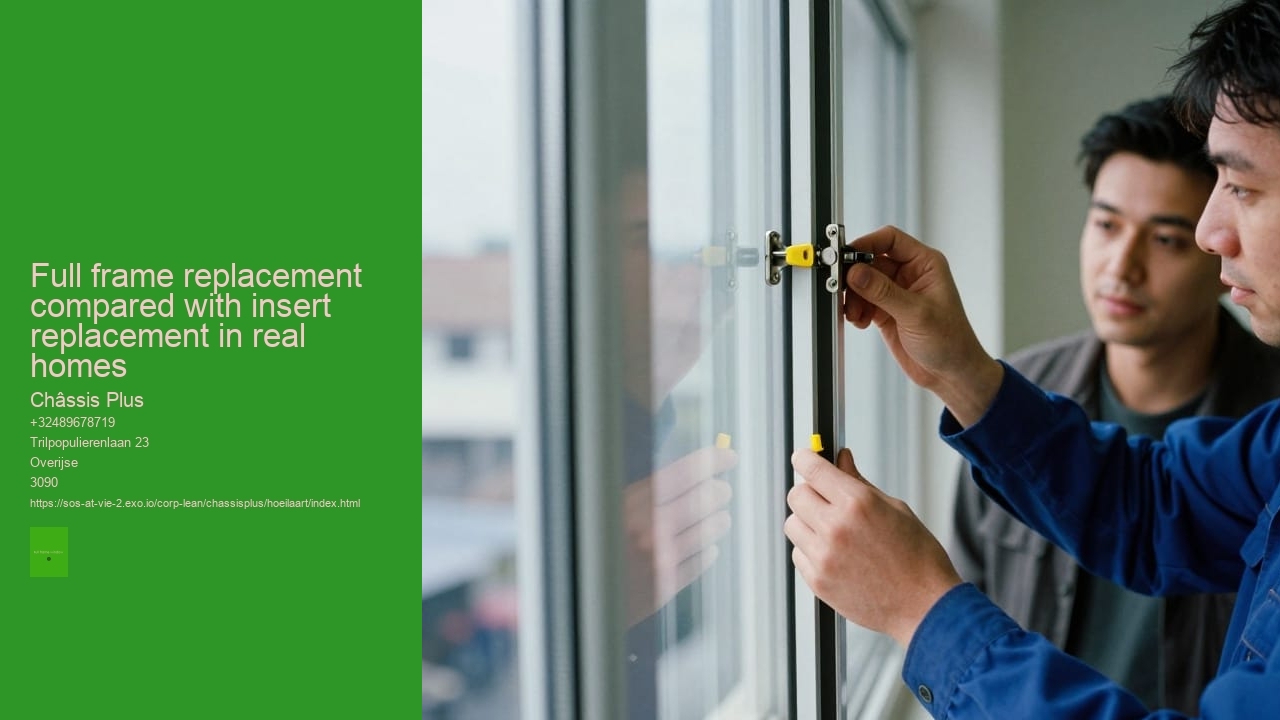
Why does your window replacement strategy matter? Think about long-term costs. Insert replacements are cheaper at first because you keep the existing frame. But if that old frame is rotting or warped, you're only delaying the inevitable. Pour des châssis PVC, alu ou bois, visitez entreprise de châssis à Hoeilaart pour voir les matériaux, les étapes et les garanties.. The rot *will* spread. You'll pay for another replacement sooner than you think. Plus, you might have to deal with water damage and mold.
When should you consider a full frame replacement? If you see frame damage—cracks, rot, peeling paint—or if the window isn’t square, go full frame. It's also needed if you're changing window sizes or styles.
How does it work? Full frame means removing everything down to the studs. Then, inspect for hidden damage, flash the opening, and install a new window. For insert replacement, the old window is removed, and the new one fits *inside* the existing frame.
What are the common mistakes? People often skip the frame inspection with inserts. They put a new window in a bad frame. Big mistake. With full frame, bad flashing is a killer. Water gets in, rots the wall, and you'll face major repairs.
If you ignore frame issues, expect higher energy bills and structural problems. Ultimately, the window will fail early. Do it right the first time to save money and headaches.
In design, a mechanism is a device that changes input pressures and activity into a wanted set of result forces and activity. Devices usually contain relocating elements which might consist of equipments and gear trains; Belts and chain drives; cameras and fans; Affiliations; Friction tools, such as brakes or clutches; Structural elements such as a frame, bolts, bearings, springs, or lubes; Numerous device elements, such as splines, pins, or secrets. German scientist Franz Reuleaux defines machine as "a mix of resistant bodies so arranged that by their methods the mechanical pressures of nature can be obliged to do work accompanied by particular determinate motion". In this context, his use of device is usually translated to mean system. The mix of pressure and movement specifies power, and a mechanism handles power to achieve a preferred set of pressures and motion. A device is normally a piece of a bigger process, referred to as a mechanical system or machine. Sometimes an entire machine may be described as a device; examples are the steering mechanism in a vehicle, or the winding system of a watch. Nevertheless, typically, a set of several mechanisms is called a device.
.A home window is an opening in a wall, door, roof, or automobile that allows the exchange of light and may likewise enable the flow of audio and in some cases air. Modern home windows are usually glazed, or covered in a few other clear or translucent product, a sash set in a framework in the opening. The sash and frame are also referred to as a home window. Numerous glazed home windows may be opened, to allow ventilation, or closed to omit inclement weather condition. Windows may have a lock or similar mechanism to secure the window closed or to hold it open by various quantities. Types include the brow home window, fixed home windows, hexagonal windows, single-hung, and double-hung sash home windows, straight moving sash home windows, casement home windows, awning windows, hopper home windows, tilt, and slide windows (commonly door-sized), tilt and transform windows, transom home windows, sidelight windows, jalousie or louvered windows, clerestory home windows, lancet windows, skylights, roof covering home windows, roof lights, bay windows, oriel windows, thermal, or Diocletian, home windows, image home windows, increased windows, fire escape home windows, stained glass windows, French windows, panel home windows, double/triple-paned home windows, and witch windows.
.In engineering, a mechanism is a gadget that changes input forces and movement right into a preferred collection of result forces and motion. Devices usually contain relocating elements which may consist of equipments and equipment trains; Belts and chain drives; web cams and fans; Links; Friction tools, such as brakes or clutches; Architectural components such as a structure, fasteners, bearings, springtimes, or lubes; Different equipment elements, such as splines, pins, or tricks. German scientist Franz Reuleaux defines equipment as "a mix of immune bodies so set up that by their means the mechanical pressures of nature can be forced to do function gone along with by specific determinate motion". In this context, his use of machine is normally analyzed to imply system. The mix of pressure and activity defines power, and a device handles power to attain a desired collection of forces and movement. A mechanism is normally an item of a larger procedure, referred to as a mechanical system or equipment. Often a whole device might be described as a system; examples are the steering system in an automobile, or the winding mechanism of a wristwatch. Nevertheless, commonly, a set of numerous systems is called a maker.
.